What to Look for in a Knife Cutting Machine: Vacuum Adsorption and Material Stability
Most buyers obsess over blade types and cutting speeds. But a sharp knife is useless if your material shifts mid-cut.
For flexible or large-format materials, the real bottleneck isn't the blade—it’s how the machine holds the material down. Without proper stabilization, the physical drag of the knife will pull the material out of alignment. If you are losing yield to misaligned paths or edge lifting, you need to look at the fixing method of your industrial cutting machine.
Why Mechanical Clamps Aren’t Enough
Mechanical clamps only secure the edges. They leave the center of the material vulnerable to dragging and bunching.
A vacuum adsorption cutting machine solves this by pulling the entire sheet flat against the work table with continuous downward suction. Instead of fighting the material, the vacuum force locks it in place across the entire working area. For porous or highly flexible substrates—like leather, foam, EVA, and sponge—this downward suction is the only reliable way to stop the material from sliding under the blade.
Making Sense of "Tracking Sub-Regional Vacuum Adsorption"
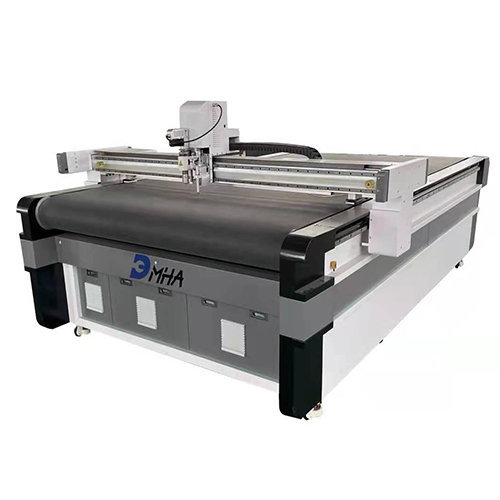
You will see different nomenclature for vacuum systems depending on the manufacturer. The DMHA-CM1625, for instance, uses a fixing method designated as Tracking Sub-Regional Vacuum Adsorption.
Stripped of the jargon, "sub-regional" means the machine relies on a partitioned vacuum bed. Instead of one massive suction zone that loses pressure easily, the table is divided into specific areas to maintain consistent holding force exactly where it's needed. "Tracking" is the manufacturer’s specific designation for how this partitioned system approaches material stabilization during the operation. It provides the steady hold required for an industrial knife cutting machine to maintain its cut path without distortion.
Matching the Machine to the Material
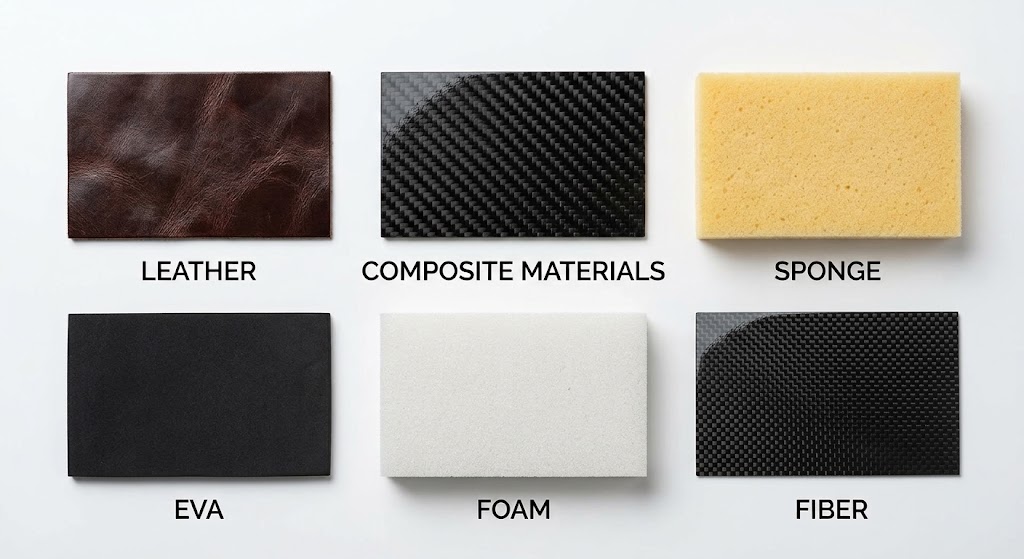
A material cutting machine is only as capable as its handling limits. The DMHA-CM1625 is built to process non-metal substrates, primarily:
⚙️Leather
⚙️Composite materials
⚙️Sponge
⚙️EVA
⚙️Foam
⚙️Fiber
Keep in mind that thickness capacity isn't absolute—it depends entirely on material hardness. Dense composite materials will max out the cutting depth far sooner than standard foam.
The Buyer’s Checklist
Don't evaluate a machine based on a single spec. Use this baseline—drawn from the DMHA-CM1625—to check against your actual production needs:
⚙️Working area: 1600 × 2500 mm (Does this cover your maximum sheet size?)
⚙️Cutting thickness: 0–50 mm (Subject to material hardness)
⚙️Precision limits: ±0.1 mm cutting accuracy, ≤0.01 mm servo resolution, and ±0.01 mm repeatability.
⚙️Material handling: Automatic feeding rolling platform (Essential if you run continuous roll materials).
⚙️Safety: Infrared induction automatic emergency stop.

Conclusion
Stop treating material fixing as an afterthought. It dictates your yield rate and your production stability. Before you finalize a purchase, ask yourself what materials you are cutting, how thick they are, and exactly how the machine plans to hold them down. Features like partitioned vacuum adsorption aren't just upgrades; for flexible materials, they are baseline requirements.
Learn more about the DMHA-CM1625 Knife Cutting Machine.