How to Choose the Right Hydraulic Climbing Conveyor for Heavy-Duty Loading
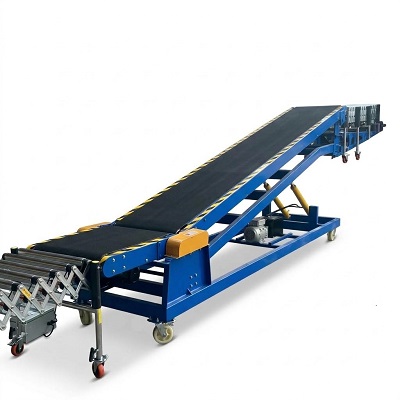 Selecting the correct material handling equipment for loading docks, warehouses, and manufacturing facilities requires a precise understanding of operational demands. When bridging the elevation gap between ground-level staging areas and shipping containers or flatbed trucks, a hydraulic climbing conveyor (also known as an adjustable incline belt conveyor) is standard equipment. However, specifying a unit for heavy-duty loading requires evaluating specific mechanical parameters to ensure stability, safety, and continuous operation under load.
This guide outlines the critical technical specifications and sizing criteria engineering and procurement teams must evaluate when sourcing a hydraulic climbing conveyor.

1. Load Capacity and Belt Width Correlation
The foundational metric for any incline conveyor is its maximum load capacity per linear meter. Heavy-duty applications—such as loading 50kg fertilizer bags, industrial hardware cartons, or oversized manufacturing components—require robust structural frames and appropriately sized belt widths.
When determining the required specifications, calculate both the maximum single-item weight and the continuous distributed load.
Specification Category | Standard Duty (e.g., Light Parcels) | Heavy-Duty (e.g., Bulk Bags, Machinery) | Application Reference (DAAP Models) |
Effective Belt Width | 400mm-500mm | 600mm-800mm | DMHA-BC600 DMHA-BC800 |
Motor Power | 1.5kW-2.2kW | 3.0kW - 5.5kW (with heavy-duty reducer) | High-torque requirements |
Frame Material | 2mm Carbon Steel | 3mm-4mm Reinforced Carbon Steel | Industrial structural stability |
Max Single Load | < 30 kg | 50 kg-100 kg | Pallet-less loading operations |
Note: Selecting a belt width slightly wider than your largest typical package prevents material overhang and potential snagging on the conveyor side guards.
2. Hydraulic Lifting Range and Target Height
The primary advantage of a hydraulic climbing conveyor is its adjustable incline. To specify the correct hydraulic cylinder stroke and boom length, measure the maximum elevation of your loading targets.
⚙️Standard Shipping Containers (20ft / 40ft standard): Floor height is typically around 1.2 to 1.3 meters from the ground.
⚙️High Cube Containers & Heavy Trucks: Can require lift heights up to 1.5 meters or more.
⚙️Multi-Level Stacking: If the conveyor is used for warehouse stacking rather than vehicle loading, the required discharge height may exceed 2.5 meters.
Ensure the hydraulic power pack and dual-cylinder lifting mechanism are rated for the maximum required height while the belt is fully loaded. A dual-cylinder system provides uniform upward pressure, preventing structural twisting when lifting heavy, off-center loads.
3. Incline Angle and Anti-Slip Belt Engineering
As the elevation angle increases, the risk of material rollback becomes a primary concern. Standard smooth PVC or PU belts lose grip effectiveness when the incline exceeds 15 to 20 degrees.
For steep incline operations, specify the following belt modifications:
⚙️Rough Top / Grip Face Belts: The textured surface increases friction, suitable for cardboard boxes and woven bags up to a 25-degree incline.
⚙️Cleated Belts (Baffles): Horizontal cleats vulcanized onto the belt surface physically block materials from sliding backward. This is mandatory for steep angles (up to 40 degrees) or when conveying cylindrical objects that tend to roll.
⚙️V-Guide Tracking: Heavy loads on an incline often cause belt misalignment. A V-guide tracking strip on the underside of the belt ensures it remains centered on the drive rollers during continuous heavy-duty operation.
4. Mobility and Operational Deployment
For facilities lacking dedicated, flush loading docks, the mobility of the incline conveyor is a critical operational factor. Heavy-duty units carry significant static weight, requiring specialized mobility hardware.
 Heavy-Duty Casters: Specify polyurethane (PU) coated cast iron wheels. They handle high load bearing capacities without damaging warehouse epoxy floors.
Locking Mechanisms: Ensure the swivel casters feature industrial-grade foot brakes or floor locks to prevent the equipment from shifting away from the truck bed during active loading.
Tow Bars/Hitches: For highly mobile operations across large yards, a tow bar allows forklifts or tuggers to reposition the conveyor safely and efficiently.
5. Tailoring to Specific Material Handling Requirements
Standard configurations handle general freight, but specialized environments require targeted mechanical adaptations. Before finalizing procurement, evaluate whether your operation requires:
Variable Frequency Drives (VFD): Allows operators to adjust the belt speed to match the handling pace of the workers inside the container, reducing bottlenecking.
Extended Horizontal Feed Sections: A longer horizontal tail section at the bottom allows workers or forklifts to stage products safely before the incline begins.
Reversible Controls: Enables the conveyor to function for both loading (incline) and unloading (decline) operations.
Requesting a Customized Equipment Assessment
Standard catalog specifications often require modification to integrate seamlessly into existing warehouse workflows. To ensure you select a hydraulic climbing conveyor engineered for your specific operational parameters, consult with technical sales engineers prior to procurement.
To receive a detailed technical proposal and CAD layout, please prepare the following data for your equipment manufacturer:
⚙️Dimensions and maximum weight of the heaviest item to be conveyed.
⚙️Minimum and maximum required discharge heights (truck/container types).
⚙️Available operating footprint and power supply specifications (Voltage/Hz/Phase).
⚙️Type of material handled (e.g., carton, woven bag, loose components).